

Inside China's Bid to Become The World Fusion Power Hub
Over the past year, China's role in the global fusion landscape has quietly but unmistakably shifted. While many Western headlines remain focused on domestic breakthroughs and private-sector milestones, developments inside China reveal a different kind of momentum. This momentum is driven by a combination of sustained engineering progress, intensified state coordination, and a notable rise in global scientific interest.
The picture emerging from official media, industry commentary, and international reporting is not merely that of a country making fusion advances, but of a system positioning itself as a potential hub for the world’s first operational burning-plasma experiment. The change is subtle, yet its implications are significant. Also read China: The Rising Power in Fusion Energy.
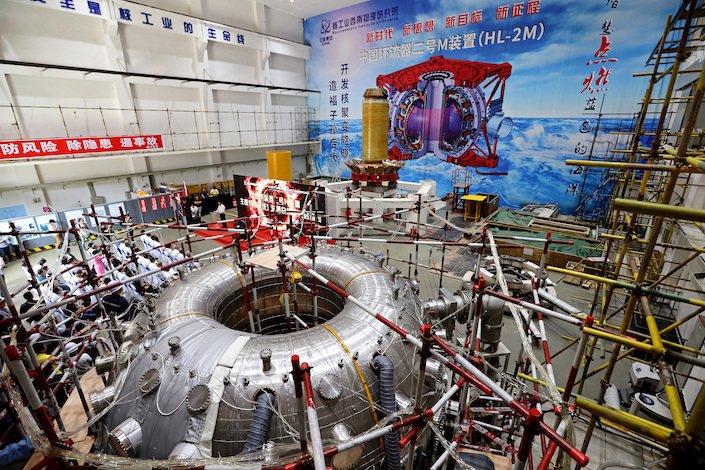
A Year of Maturing Engineering Credibility
One of the defining themes of China’s 2025 fusion narrative is engineering credibility. Unlike many fusion programs that often emphasize scientific records, several Chinese facilities have reported concrete progress on reactor-relevant systems.
For instance, China recently announced that a key divertor prototype—a critical component for managing extreme heat and plasma exhaust in a fusion reactor—passed expert review under its major facility program. This kind of subsystem acceptance indicates a maturing capability that extends beyond basic plasma experiments and into industrial-level design and manufacturing readiness.
In parallel, reports from Chinese authorities describe growing coordination among research institutes, state-owned energy firms, and manufacturing units. They are working to build out a full supply chain for fusion components, from superconducting magnets to high-precision materials. Rather than focusing on incremental physics experiments alone, China is deliberately building a comprehensive fusion ecosystem.
International Talent Is Quietly Moving East
A less-noticed but highly significant shift is the movement of international talent toward China. Several leading European nuclear scientists have recently joined China’s Burning Plasma Experimental Superconducting Tokamak (BEST) project in Hefei.
These researchers, who previously worked in Europe’s major fusion programs, have expressed confidence in China's faster timelines and integrated engineering approach. Their decision reflects a growing belief in China’s stable infrastructure, concentrated timelines, and unified strategy toward engineering and research.
This influx of high-level international talent suggests China is now being seen not just as a participant in the global fusion race, but as a credible platform for future research. This effect is subtle but potentially transformative: as capability, funding, and human capital converge, China strengthens its claim as a future global hub of fusion innovation.
Strategic Narrative Hardens: Vision Becomes Reality
The strategic narrative for fusion has also hardened within China. At the opening ceremony of the IAEA Fusion Energy Conference in Chengdu, the head of the China Atomic Energy Authority (CAEA) declared that fusion energy is a central pillar of China’s clean-energy strategy. He emphasized the country’s commitment to building large-scale scientific infrastructure, deepening cooperation among research institutions, and working with global partners to accelerate fusion development.
In a parallel institutional move, China was selected as the site of the first IAEA “Collaborating Center for Fusion Energy Research and Training,” hosted by the Southwest Institute of Physics (SWIP) in Chengdu.
Taken together, these developments suggest China is no longer on the periphery—it is establishing itself at the center of global fusion governance, collaboration, and institutional infrastructure. Chinese officials portray these partnerships as part of a “shared future for the fusion community,” positioning China as a hub for coordinated international research, particularly for countries not deeply embedded in ITER or U.S.-based private fusion programs. Regardless of the stated intention, this clearly reflects a shift in how China sees its own role: not just catching up, but offering a global fusion platform.
The Emergence of a Multipolar Fusion Landscape
What emerges from China’s 2025 trajectory is neither media hype nor imminent dominance, but structural momentum. With steady engineering progress, an inflow of global talent, and formal international mandates via the IAEA, China is staking a serious and institutionalized claim as a global fusion hub.
Fusion energy may still be decades away from powering commercial grids. However, the architecture for a multipolar, institutionalized, and globally networked fusion industry is beginning to take shape—and China appears to be one of the principal builders.
Whether this ambition succeeds depends less on bold statements and more on technical execution, sustained collaboration, transparent governance, and realistic delivery. But in 2025, China's fusion ambition has moved from scattered experiments to a coordinated global play. That alone warrants serious attention.

