

Robotics, The Commercial Spillover of the Fusion Economy
As global interest in fusion energy accelerates, much of the attention remains centered on high-profile physics milestones, AI-assisted reactor design, and record-breaking plasma experiments. But beneath these achievements lies an equally critical story rapidly taking shape: the rise of robotics as a foundational pillar of the fusion industry. Recent developments in the UK, China, and across Europe suggest that robotics could become one of the first commercially viable sectors surrounding fusion—potentially years before fusion delivers its first electrons to the grid.
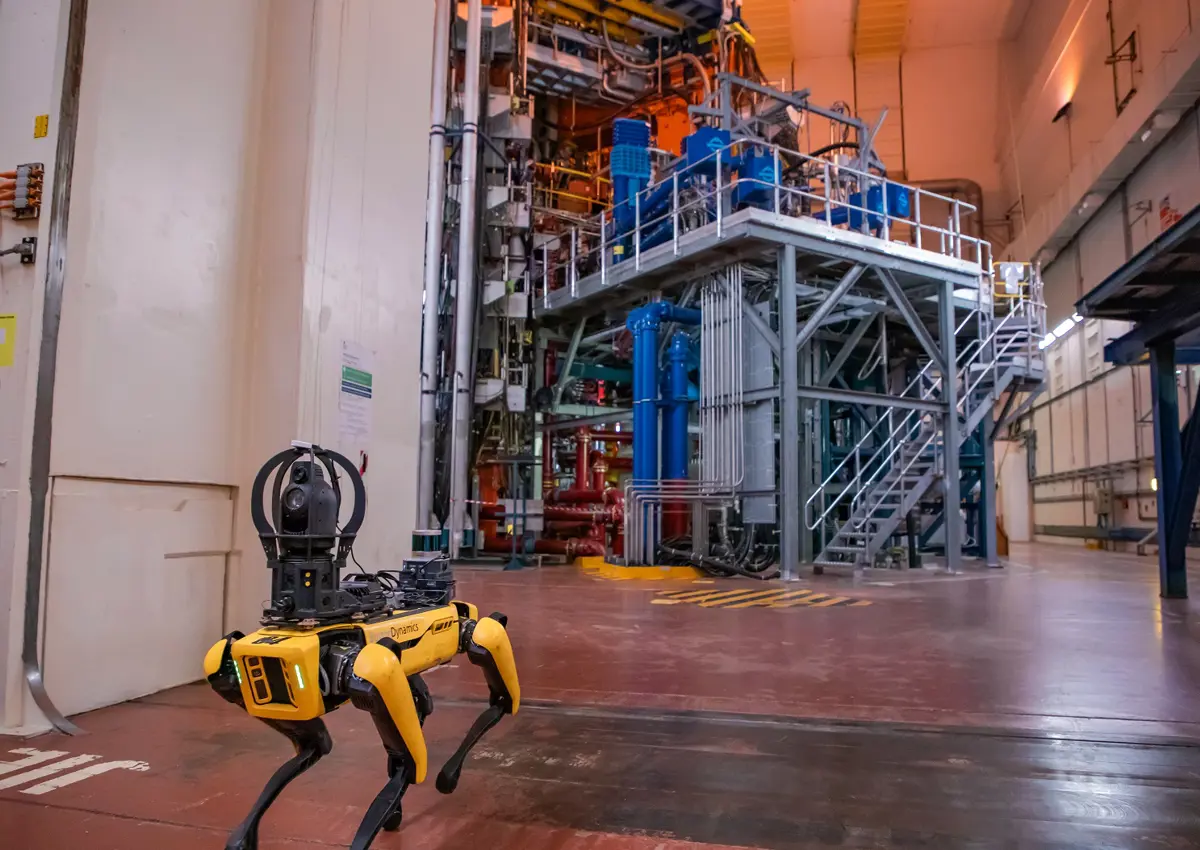
Robotics: An Operational Imperative for Fusion
Fusion reactors are engineered to operate in environments where extreme conditions demand precision, predictability, and safety beyond what is feasible for human presence. The combination of intense heat, neutron radiation, strong magnetic fields, and highly confined spaces means that next-generation reactors will integrate robotics as a core operational system from the start.
This is why organizations like the UK Atomic Energy Authority (UKAEA) describe robotics not as an optional enhancement but as a mandatory requirement for the operation of any future fusion power plant. Their 2025 report, Robotics Challenges for Fusion Energy, outlines the necessity for robot systems that are significantly more capable than anything used in current nuclear facilities: systems that must be:
Radiation-tolerant: Able to operate reliably under constant neutron flux.
Precision-capable: Performing millimeter-level manipulation tasks.
Autonomous: Executing complex procedures without constant human intervention for extended periods.
Landmark Breakthroughs Reshaping the Field
Several landmark breakthroughs demonstrate just how quickly this field is advancing, moving from theoretical concept to practical demonstration.
The UK’s Leadership in Remote Handling
Researchers at Oxford Engineering recently unveiled a world-first autonomous robot designed explicitly for fusion reactor maintenance. This system can navigate reactor interiors and manipulate components without direct human control—an essential capability for any future commercial fusion plant.
The UKAEA, in partnership with RAICO, has emphasized that robotics will be central to the country’s STEP program, positioning the UK as a global leader in sophisticated remote-handling technologies.
In a significant industrial milestone, a UK fusion facility recently achieved a "robotic world-first" by using remote-handling systems to complete a full component removal and replacement cycle. This proven capability signals that robotic-assisted maintenance is no longer theoretical but demonstrably achievable.
China’s Strategic Robotics Investment
In 2024 and 2025, Chinese research initiatives introduced what is considered the largest radiation-proof robot designed for fusion operations, alongside advanced robotic arms capable of performing high-precision tasks inside reactors.
These developments signal China’s clear intention to secure a leadership position not only in core fusion research but in the enabling robotic and engineering technologies required to build and operate such plants.
Academic advances continue to support this momentum, with new research documenting complex multi-arm coordination systems and real-time control architectures tailored specifically for the harsh and dynamic fusion environment.
The Untapped Business Opportunity for Robotics
What makes this moment particularly compelling is the vast scale of the early-market opportunity robotics introduces. Fusion power plants will require an entirely new supply chain for specialized components that are not currently mass-produced:
Radiation-Resistant Hardware: Large volumes of specialized sensors, cameras, motors, and control systems.
Advanced Robotics: Remote-handling arms, AI-driven autonomous maintenance systems, and robotic inspection drones.
Digital Infrastructure: Digital twins and simulation platforms integrated with robotic systems for planning and execution.
Crucially, even the construction of fusion plants will depend heavily on robotics, given the need for precision assembly, welding, and transportation of heavy components in environments too dangerous for humans.
This creates a rare early-market window. While commercial fusion electricity may still be years away, robotics for fusion is needed now for ongoing operation, testing, and maintenance at major facilities like UKAEA, ITER, and private fusion companies. For robotics firms, whether specializing in hardware, vision AI, autonomy, or remote-handling integration, fusion offers:
A Pathway to Early Revenue: Immediate contracts for development, testing, and system integration.
Strategic Partnerships: Collaborations with leading national labs and well-funded private ventures.
Cross-Sector Technological Spillover: Innovations developed to survive the fusion environment like radiation-hardened electronics, can directly benefit industries like fission energy, defense, offshore infrastructure, mining, and space robotics.
Robotics as an Accelerator for Fusion Deployment
In many ways, the robotics sector may scale faster than fusion itself. The risks are lower, the demand is clearer, and the technologies have broader cross-sector applicability. If fusion becomes the clean-energy breakthrough of this century, robotics will be one of the essential industries that enabled its engineering and commercialization. Conversely, if high-reliability, autonomous systems become the next major growth field, it may be the extreme technical demands of fusion that pushed its development forward.
The fusion sector often frames itself as being on the edge of a scientific revolution. But as the world moves from fusion research to fusion deployment, the real revolution is increasingly industrial and engineering-focused. The past two years were marked by physics breakthroughs; the next few may well be remembered as the rise of fusion engineering, powered by robotics.
