

CEP Forward Look at the 2026 Fusion Industrial Frontier
The global energy transition reached a historic inflection point in 2025. Fusion has moved from experimental laboratory science into a rapidly maturing industrial sector. Scientific validation, regulatory clarity, capital market readiness, and emerging corporate demand have converged, transforming fusion from a concept into a commercially relevant industry.
As 2026 begins, the strategic question is no longer whether fusion works, but who will scale first, secure supply chains, and establish the initial generation of utility-scale fusion infrastructure. Execution, not observation, will define leadership.
2025 Retrospective: Foundations for Industrial Readiness
2025 set the stage for industrial execution by establishing financial, regulatory, and commercial foundations:
Capital Momentum: Global private investment surpassed $15 billion, reflecting a shift from speculative R&D to industrial-scale opportunity. The $6B TAE–TMTG merger enabled immediate construction of a 50 MWe utility-scale plant.
Corporate Validation: Hyperscale tech firms became anchor customers through landmark PPAs: Google with CFS (200 MW), Microsoft with Helion (50 MW), and Japan’s Aoki Super with Helical Fusion.
Regulatory & Geopolitical Progress: Germany, the U.S., and UK streamlined permitting, while China advanced the BEST Tokamak toward net-energy demonstration, illustrating diverse national strategies.
These developments primed fusion for industrial build, providing clarity, liquidity, and market validation.
2026 Industrial Trajectory
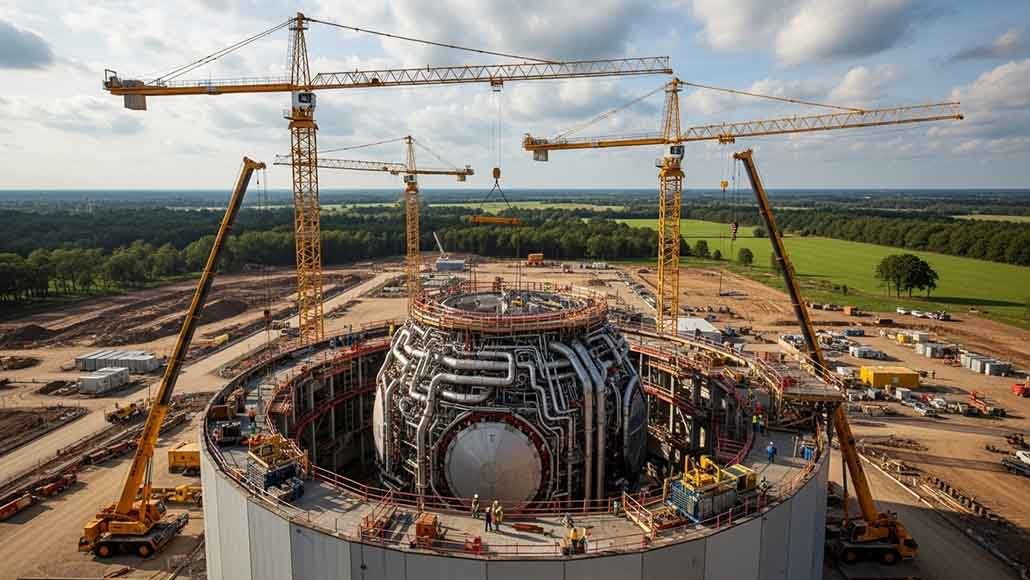
In 2026, fusion enters a decisive phase where industrial execution, supply chain mastery, and operational reliability will define early leaders. Companies and regions that align engineering readiness with regulatory and commercial strategies will establish the benchmarks for utility-scale deployment.
Engineering & Power Plant Readiness
GIGA Blueprint Review: The Gauss Fusion 1,000-page conceptual design is undergoing independent review, transitioning Europe’s “Eurofighter for Fusion” from concept to constructability and setting design and operational reliability benchmarks.
TAE’s Public Market Advantage: Following the $6B TAE–TMTG merger, TAE is finalizing siting and beginning construction of the world’s first 50 MWe utility-scale plant, establishing a reference point for early commercial fusion.
CFS and the ARC Path: CFS is entering Series-1 production of high-temperature superconducting (HTS) magnets. The ARC plant is positioned for first-mover operational readiness in North America, setting standards for grid-scale deployment.
U.S. Industrial Deployment Highlights
Key U.S. projects in 2026 will define industrial benchmarks:
Virginia (CFS): ARC plant advances toward grid-scale deployment under non-fission regulatory frameworks.
Washington (Helion Energy): Orion plant progresses toward 2028 Microsoft delivery, demonstrating corporate off-take as a viable industrial pathway.
Tennessee (Type One Energy): 350 MW Infinity Two plant with TVA repurposes retired coal infrastructure, illustrating clean baseload integration.
These projects highlight the importance of regional execution, corporate partnerships, and regulatory alignment in early competitive positioning.
AI-Driven Digital Twins & Operational Reliability
2026 will mark the first industrial deployment of AI-driven digital twins for real-time plasma management. Deep reinforcement learning enables millisecond-scale self-correction of plasma instabilities, ensuring 90%+ uptime—a critical metric for profitable baseload operation. Early adopters are expected to define operational benchmarks and separate scalable operators from experimental projects.
Supply Chain as a Determinant of Industrial Leadership
Supply chain mastery will distinguish winners:
HTS Scaling: Series-1 REBCO production lines determine who can deliver utility-scale magnetic fields efficiently.
Advanced Materials: Tungsten and high-entropy alloys are qualified for extreme thermal and neutron loads.
Tritium Self-Sufficiency: Lithium-based breeder blankets enable independent fuel cycles for scalable baseload deployment.
By year-end 2026, operators combining engineered readiness, robust supply chains, AI-enabled operations, and early corporate partnerships will set the standard for industrial execution, shaping the next decade of fusion commercialization.
From Startup Investment to M&A: The 2026 Pivot
With fusion moving into utility-scale construction, the window for low-cost entry is closing. Energy majors, utilities, and tech giants are transitioning from passive investors to strategic acquirers, targeting technology control, supply chain moats, and regional exclusivity.
The Pivot: From Venture to Platform Ownership
Energy Supermajors: Acquire supply chain moats—tritium handling, HTS manufacturing, AI diagnostics.
Utility Giants: Shift from partnerships to controlling joint ventures or full acquisitions to secure first-mover rights in regional grids.
Tech Hyperscalers: Move from customers to acquirers, securing proprietary power for AI workloads and data-center dominance.
Following the TAE Public Benchmark
The $6B TAE–TMTG merger established the “Fusion Major” tier ($5–10B pre-commercial).
Helion Energy: With 2028 Microsoft PPA and Orion facility costs, poised for a public listing in late 2026 or early 2027.
CFS: Construction of multiple ARC plants may drive IPO, unlocking institutional clean-energy funds.
As industrial-scale construction begins, total public market capitalization for the fusion sector could reach $20–30B by year-end 2026.
Strategic Implication
Investors: Early returns hinge on execution. Modular designs, integrated supply chains, and PPAs will deliver the first commercial impact.
Energy Majors: Industrial backbone opportunities (cryogenics, materials, power electronics) provide ROI while plants are under construction.
Policymakers: Transition from R&D grants to industrial policy execution—fast-track permitting, workforce development, and supply chain localization—positions regions as fusion hubs.
Strategic Windows Close Quickly
2025 confirmed that fusion is technically achievable. 2026 will determine which stakeholders define the industrial foundation for the next era of energy. Success will accrue to those who act decisively on engineering readiness, supply chains, regulatory alignment, and strategic partnerships. Fusion is no longer an experimental concept—it is an emerging industrial reality, and 2026 is the year execution defines leadership.

